In this article, I compare a spray tan and a tanning bed: how each one tans you, what Canadian sources say about their safety, and what Quebec law covers.
The short answer
The Canadian Cancer Society is clear: indoor tanning is never safe. On the same page, it says sunless tanning products, spray tans included, have not been shown to pose a health risk and are considered safe to use, if they are applied correctly and carefully.
I chose sunless tanning for that reason. I have always paid close attention to skin and its health, and every session starts with a look at your phototype and your undertones before I mix your shade.
| Spray tan | Tanning bed |
|---|
| UV rays | None | Yes, UVA and UVB |
|---|
| How it tans you | Colours the outer layer of dead skin cells | Your skin makes pigment to defend itself against UV |
|---|
| When it fades | The colour leaves with the surface layer | The tan fades, the damage stays |
|---|
| Sun protection | None | Almost none |
|---|
| Under 18 in Quebec | Not covered by the law (no UV) | Banned in tanning salons |
|---|
With my spray tans, the first rinse comes 1 to 5 hours after the session and the final colour is there after 24 hours. They last 7 to 14 days, depending on your skin and your aftercare. I explain it in how long a spray tan lasts.
How each one tans you
A tanning bed sends UV rays into your skin. Your skin reacts by producing more pigment to defend itself. The Canadian Cancer Society sums it up in one sentence: tanned skin is damaged skin.
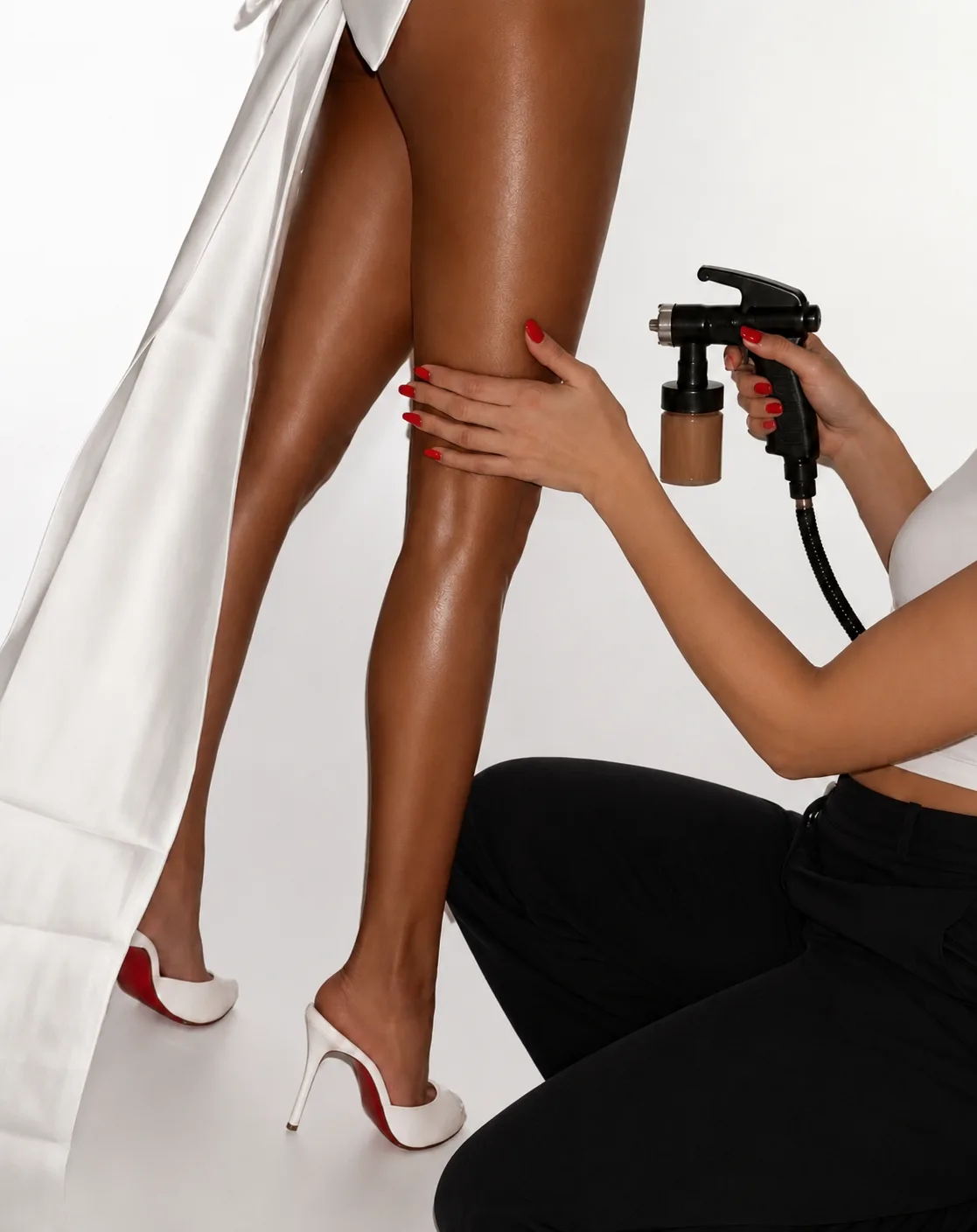
A spray tan works on the surface. Its active ingredient, DHA, reacts with the outer layer of your skin, made of dead cells, to produce colour, as the Canadian Dermatology Association explains. That layer renews itself, which is why a spray tan fades after a while instead of staying.
What we know about tanning beds
According to the Canadian Cancer Society, UV-emitting devices such as tanning beds are classified as known causes of cancer. It is the highest rating on that scale.
The Canadian Cancer Society also reports that using indoor tanning equipment before the age of 35 leads to a 59% increased risk of melanoma. And when the tan fades, the damage stays.
Is a spray tan safe?
For the Canadian Cancer Society, sunless tanning products are considered safe when they are applied correctly and carefully: on the outside of the skin only, without breathing them in or swallowing them. It asks that the eyes, nose and lips be protected, even when the spray tan is done by a professional. The Canadian Dermatology Association makes the same recommendation. When I spray your face, I ask you to close your eyes and hold your breath for 2 to 3 seconds, so you do not breathe in the solution. At the end of the application, I wipe your lips to remove the product.
Some products also contain fragrances and preservatives, which can cause a reaction on some skins. If your skin is sensitive, tell me when you book, and we will talk about it before the session.
What Quebec law says
Since 2013, Quebec has a law to prevent skin cancer caused by artificial tanning. Section 1 defines artificial tanning as a tan obtained with a device that emits ultraviolet rays, such as tanning beds and booths.
Under section 3, a tanning salon cannot offer artificial tanning to anyone under 18. A spray tan emits no UV, so it is not artificial tanning in the sense of the law. The text is on LégisQuébec.
That is why I also do spray tans for clients under 18, for example before a prom. I do it with a parent's consent, and a parent is always present during the session.
The base tan myth
Some people go to a tanning bed before a trip, to build a "base tan" that would prevent sunburn. The Canadian Cancer Society says a tan offers almost no protection from sunlight or burning.
A spray tan does not protect you either. Neither option replaces sun protection: keep applying sunscreen when you are out in the sun.
Before your event
For a wedding, a gala or a trip, plan your spray tan session 1 to 2 days before. Your final colour is there after 24 hours, ready for the event. Everything about my service is on the sunless tanning page.